
Patrick Hayes chaired this first monthly meeting for the 2026-2027 season. The meeting room at St Michaels Catholic Secondary School (classroom 102) had 14 attendees ready for presentations by Ken Roberts and Michael Burns.
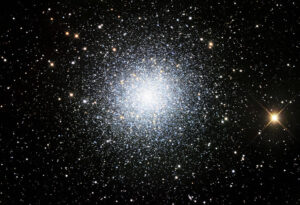
Ken presented his study of M13, known as the Great Hercules Cluster. It is a globular cluster in the Hercules constellation, one of the brightest and best-known in the northern sky.
As Ken pointed out, M13 is a naked-eye (barely) target in the northern sky, which makes it approachable for hands-on observational work.
Ken’s presentation is very detailed. You can view it here
Globular clusters are some of the oldest, well-structured objects in the cosmos. They are near enough to Earth to be observed in detail. In principle, globular clusters are dense, roughly spherical collections of stars, tightly bound by gravity, that orbit a galaxy’s core.
M13 fits that profile well: it packs several hundred thousand stars into a ball a few hundred light-years across, sitting about 22,000-25,000 light-years away in the constellation Hercules.
The stars are old — mostly ancient, “Population II” stars, some over 11 billion years old — which is typical of globulars, in contrast to open clusters (like the Pleiades), which are younger, looser groupings of stars found in a galaxy’s disk.
M13 is visible to the naked eye under dark skies as a faint smudge, and it’s a popular target for binoculars and small telescopes — through a decent-sized scope, you can start to resolve individual stars near its edges.
M13 is approximately 11-12 billion years old, making it one of the oldest objects in our Milky Way. This means it formed early in the galaxy’s history, only a few billion years after the Big Bang.
Ken stressed that globular clusters are known as pulsar factories. In a dense globular cluster, old neutron stars can undergo close stellar encounters or capture a binary companion. Matter accreting from that companion spins the neutron star up to millisecond rotation periods — a process called “recycling.” That’s why cluster pulsars are almost always millisecond pulsars rather than the young, slow pulsars you find in supernova remnants. But the Hercules Cluster has a modest number of 5-millisecond pulsars, says Ken.
He closed his presentation by noting that M13 and other clusters offer budding scientists in many different disciplines, ranging from astronomy and physics to chemistry and biology to computing and artificial intelligence, many opportunities for exploration and analysis.
Michael Burns followed Ken and presented his Cool Comic Observations for September. Michael also delivered a high-level discussion on new smart telescopes, the ZWO Seestar S50 Pro and the DwarfLab Dwarf.
Stay tuned. More will be posted regarding Michael Burn’s presentations.
The next club meeting is Tuesday, October 13 at 7:00 pm.
Tom Kimber – News