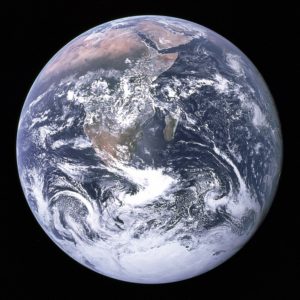
December 7, 1972, by the crew of the Apollo 17 spacecraft en route to the Moon at a distance of about 29,000 kilometres (18,000 mi). It shows Africa, Antarctica, and the Arabian Peninsula.
Dr. Michael Burns presented his Cool Space/Cosmology/Astrophysics News for June.
Click here for a review of the June 2 meeting. As well, see the Agendawith notes.
The next meeting at St. Michael’s High School is in September, set for 7:00 pm, likely on September 8.
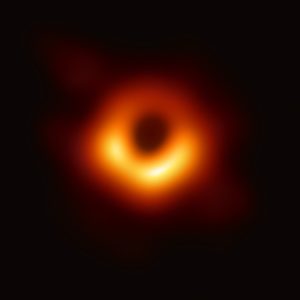
In 2019, the first picture of a Black Hole was published. Now, astronomers are developing a video of the same Black Hole located at the center of M87. Journalist Catherine Zhu writes about it in the CBC. You can read her fascinating story here and also listen to a Quirks and Quarks program on the background of this project.
SAG’s own Dr. Michael Burns has been involved in this Event Horizon Telescope (EVT) project.
The year’s best meteor shower occurs this month. On August 12, a partial solar eclipse is visible. Then, two weeks later, a partial lunar eclipse occurs. The August full moon (the Sturgeon Moon) is seen on August 28. The maximum solar eclipse is visible in the Stratford area at 4:13 am
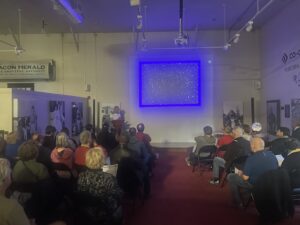
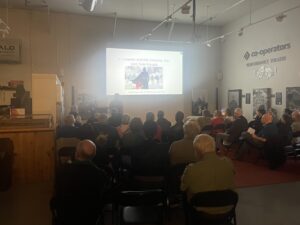
The Stratford Astronomy Group (SAG) drew 47 people to a Star Party at the Stratford-Perth Museum on Thursday evening, May 27, where attendees took in astronomy presentations and later viewed the night sky through a range of telescopes. Hosted by Kelly and the museum staff, the event brought together experienced observers and first-time skywatchers for an evening of learning and hands-on discovery.
The evening began indoors with three engaging presentations from SAG members, each offering a different window into astronomy, before attendees moved outside for an observing session behind the museum.
Denis and the night sky
Denis Desmeules opened the program with an accessible look at how the sky changes through the day and across the seasons. He explained the Sun’s path, shifting shadows, and how Earth’s orbit changes what we see overhead throughout the year. With a May 2026 sky map, he also gave attendees a practical guide to what they could expect to spot that night and in the days ahead.
Patrick explains Dark Matter
Patrick Hayes followed with a compelling tour of the universe’s hidden side, covering black holes, dark matter, and dark energy. Moving from the collapse of massive stars to the expansion of the universe itself, he highlighted a striking truth: everything we can see is only a small fraction of what exists.
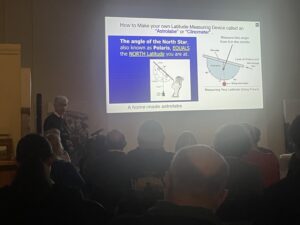
Bruce explains an Astrolabe
Bruce Simpson wrapped up the indoor program with practical skywatching tips, using the Big Dipper to show how to find Polaris, bright stars, and other celestial landmarks. His presentation connected familiar patterns in the night sky to the larger skill of navigating and understanding what appears overhead.
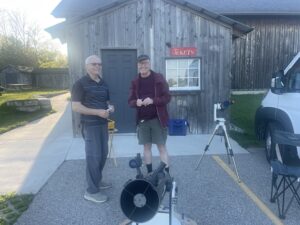
After the talks, attendees headed outside to a lineup of Dobsonian reflectors, refractors, and SeeStar S50 smart telescopes, where the evening’s ideas quickly became real views of the sky.
Tom and Bob preparing scopes
The mix of traditional eyepiece viewing and live digital imaging gave visitors two very different ways to experience the sky. Some enjoyed the direct connection of looking through a telescope, while others were drawn to the colour-enhanced images building in real time on digital screens. Together, the instruments sparked conversation, curiosity, and plenty of excitement.
By night’s end, the Star Party had done exactly what it set out to do: bring people closer to the sky, deepen their understanding of what they were seeing, and leave them eager for the next chance to look up.
We observed Jupiter and 4 of its moons – Io, Europa, Ganymede and Callisto. Almost a full Moon as well, big and swelling in the eyepieces. On May 31, we will witness a once-in-a-blue-moon event. When a full Moon appears twice in the same calendar month. Appropriate for our Star Party.
December 7, 1972, by the crew of the Apollo 17 spacecraft en route to the Moon at a distance of about 29,000 kilometres (18,000 mi). It shows Africa, Antarctica, and the Arabian Peninsula.
You can click here for a review of the May 5 meeting.
Dr. Michael Burns presented his Cool Space/Cosmology/Astrophysics News. A link ot this PDF is contained in the minutes above.
Next meeting at St. Michael’s High School is set for 7:00 pm, June 2.
NASA remains focused on future Moon landings, but without a lunar orbit space station.
With a new chief, Jared Issacman installed, NASA announced major changes to its Artemis moon program. Artemis II can lift off as early as April 1 for a 10-day mission.
Canadian Astronaut Jeremy Hansen’s hometown is Ailsa Craig, not far from my hometown, St Marys, Ontario. He is about to make space history with his mission in the Artemis II launch, scheduled for as early as February 8. Read this interesting story by Jack Sutton published by CBC News. To read, you can click here.